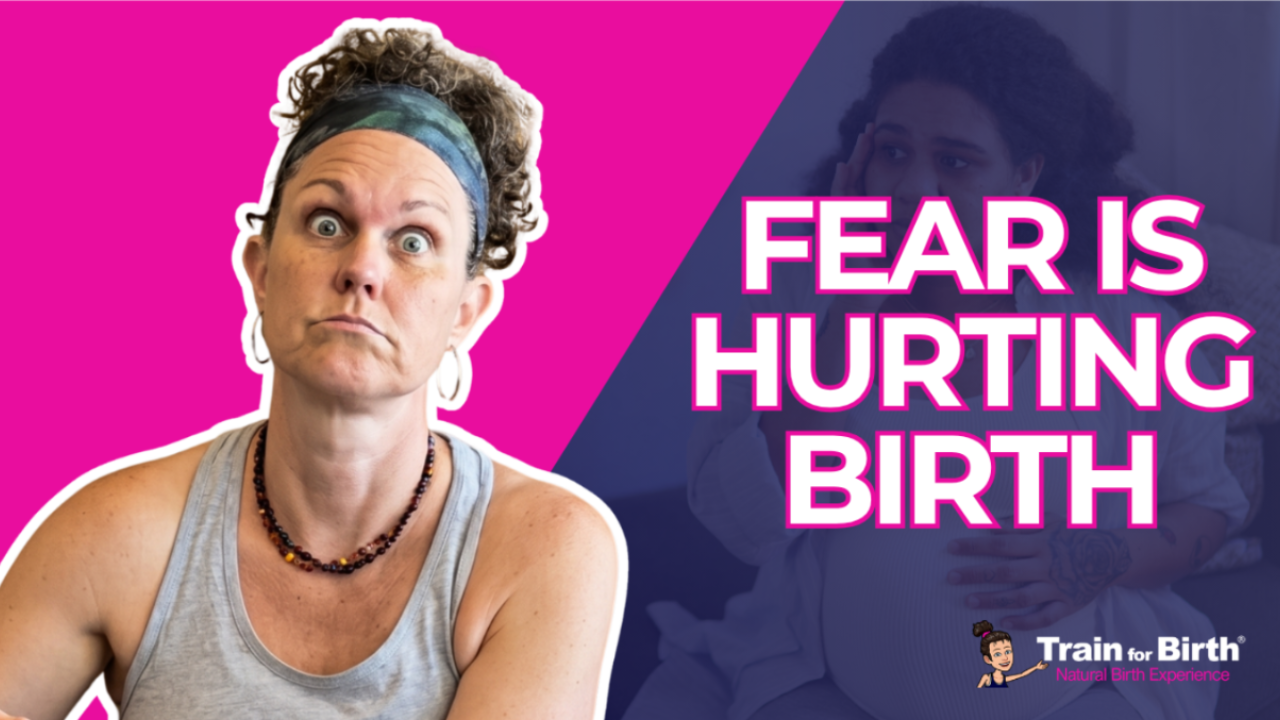
What NOT to Fear on Your Birthing Game Day (from my 100+ births)
When it comes to childbirth, fear is everywhere.
It comes through the TV, from your provider, from loved ones sharing their stories. My body won’t dilate. Tearing. Hemorrhaging. Hospitals being controlling. Long labor. Unplanned C-sections. Uterine rupture. The unknown.
These are the things being communicated to expecting parents every single day, and about 98% of us in the United States are birthing in hospitals because that is what we are conditioned to believe is the only option.
Realistically the medical world has done a fantastic job of marketing their services over the last 150 years!!
Here is the truth: most of what you are hearing is blown out of proportion. A lot of the wording being used is designed to get you to comply with what someone else wants you to do.
You need to pay attention to what you are being told, and you deserve to know that you have choices.
The Truth about C-Sections
33% of women are having cesareans whether they are medically necessary or not. That is out of 100 hundred women 33 will have a surgical birth.
Do you know that a cesarean is the #1 ROUTINE surgery in the United States?
Why does this matter? Because the World Health Organization has cited that up to half of those C-sections are not “medically necessary.”
Often, they’re done out of convenience for the hospital, not the well-being of the mother or baby.
Then, once you’ve had that C-section, you’ll be told "Once a cesarean, always a cesarean.” Any other children to expand your family dynamic will have to be delivered via C-section.
NOT TRUE!!
The #1 scare tactic used around VBAC (vaginal birth after cesarean) is uterine rupture, which is a risk of less than 1%. It gets blown completely out of proportion.
VBAC has a 99% change of NO uterine rupture, yet you are feared by that 1%.
Some providers are simply not trained, do not feel competent performing a vaginal birth after cesarean or prefer to deliver babies surgically, so they steer you away from it. That is about their skillset and fear, not your body's ability.
Really, there are two philosophies in birth.
1: Pathology, where the focus is on fixing, intervening, and managing labor and delivery. Such as doctors, a trained surgeon, in a hospital.
2: Physiology, where the understanding is that the body knows what to do, and the job is to support this amazing Godly phenomenon. Midwives are trained in physiological birth.
As an expecting parent, you need to decide which philosophy you want and find a provider who matches it. That includes having a child vaginally after a C-Section.
Breech Is Not Bad
A major cause of those unnecessary C-sections is a breech baby. However, this often comes down to the inexperience of the doctor or hospital policy, not the needs of the mother and baby.
Breech (meaning, babies positioned any direction other than head-down) is not a disaster. Breech is a variation of normal!
I have attended several breech home births!!
3-4% of babies will be born breech because they need to be.
The fear around breech exists because many providers are not trained or competent in delivering a breech baby vaginally, so the default becomes a cesarean.
The circumference of the baby's head coming through the pelvis is the same circumference as the baby’s butt coming through the pelvis. Either way, a baby can be born vaginally.
The only presentation that requires a cesarean is a transverse lie, where the baby is laying sideways across the top of the pelvis. Head first or butt first, a vaginal birth is possible with the right competent, trained provider.
If you have a breech baby, you may need to cross country borders or state lines to find a trained breech vaginal provider.
Depending on where you live that may take some searching, but it is worth it.
Your Body Is Not on a Clock
Your body is designed to labor on its own. Your labor will not look like your sister's or your best friend's. Everybody, every birth is different. If you are healthy and your baby is healthy, there is no reason to rush.
Your oxytocin levels need to rise. You need to feel safe, vulnerable, and supported. That is how a baby comes out of your body. If you are scared, tense, and fearful, your body will freeze up, just like any mammal that feels threatened during birth by a predator.
A laboring animal in the wild will not birth if it does not feel safe. It will find a safe place first. Humans are no different.
The #1 reason for a cesarean is failure to progress, and one of the leading causes of failure to progress is lack of food and water during the birthing process.
When you are running your birthing marathon, your body burns calories, your uterus needs hydration and food to have the power to continue contracting, and if you are starving and dehydrated, nothing progresses. Your body goes into stress, your baby goes into stress, and suddenly you are in the operating room for a situation that began with something as simple as not being allowed to eat or drink.
If you are birthing outside of a hospital, the rule of thumb is to put something in your mouth every 30 minutes. Your body is working hard. Feed it accordingly.
The Four Ps of Pregnancy (From a Chiropractor's Perspective)
Chiropractic care, specifically from a Webster Certified chiropractor, addresses four key factors that directly affect your birth experience.
Power comes from the uterine forces pushing down through your pelvic inlet. The nerves that control that area run through your lower back. When everything is aligned, you have the power your body needs to birth your baby.
Passage is the physical space your baby travels through. The pelvis, your pubic bone, your hips, and your tailbone all create that passage. Life is cumulative. Car accidents, falls, years of sitting, sports injuries, all of it can cause your pelvis to twist or tilt and that passage to narrow. A narrowed passage can create what providers call dystocia, or failure to progress, and sometimes that gets blamed on the size of your baby's head when the real issue is alignment. A good sign that your passage may be compromised: sit or lay down and look at your feet. If one appears shorter than the other, your pelvis may be out of alignment. That is something that can be corrected safely and without pain.
Passenger refers to your baby and their position. Two common reasons babies end up breech: a short cord and tight round ligaments. Two round ligaments that support the front side of the uterus can cause lower abdomen pain, pubic bone area pain down into the groin during pregnancy, can prevent your baby from rotating head down. Releasing that ligament through chiropractic care is one of the most effective tools for encouraging proper fetal positioning. In 13 years of being a birth professional, 18 out of 20 breech babies returned to the correct position with chiropractic care. The two that did not were due to a short cord.
Postpartum matters too. Once the baby is born, pain shifts from your lower back and hips up into your upper and middle back. You are looking down to feed your baby, carrying heavy car seats, and not getting enough sleep. If feeding your baby is physically painful every single time, that connection gets disrupted. Chiropractic adjustments postpartum helps restore alignment, and research shows that adjustments can also help boost dopamine levels, which can play a role in preventing postpartum depression.
How to Avoid Tearing
Avoid purple-face pushing on your back. When you are coached to curl over your baby and bear down as hard as you can, that is what increases the chance of tearing. That style of pushing typically accompanies epidurals, because when you cannot feel what is happening, you have to force the baby out manually.
Here is something most people are not told: you could be in a coma and your uterus would still push your baby out. Your uterus is designed to house your baby for nine months, give or take a few days or weeks and then evict the baby from the womb house earthside.
If you wait for the moment your body spontaneously begins pushing, if you breathe and surrender to that process rather than fight it, your body will push your baby out at the correct speed. Tearing becomes far less likely when you let your body lead and birth in the position you choose in that moment.
Exercise and Movement Through Pregnancy
Staying active through pregnancy improves circulation, reduces swelling, gives you more energy, cuts down on discomfort, and prepares your body for birth. Keep it low impact. High impact exercise, anything involving a lot of bouncing or jumping, can risk separating the placenta from the uterine wall, so avoid that.
If you were already running before pregnancy, you can continue to run until it starts to be uncomfortable. If you have never exercised before, start with short walks and build up gradually to a brisk pace. I recommend building up to 3-5 miles or 10,000-15000 steps during your wake hours of each day. Movement is what matters.
Avoid sitting on your feet or crossing your legs for extended periods, as both create torsion in your pelvis. Avoid sitting on your tailbone; sit back on the full base of your pelvis and straighten up from there. And avoid high heels or unsupportive footwear.
Drink half your body weight in ounces of water every single day. Eat well. These are not extras. They are foundations your humans body needs daily to support a healthy baby.
1`
What to Ask Your Provider
In a typical OB appointment, you have about 11 minutes. Write your questions down and bring them to every prenatal visit.
Two of the most important questions you can ask any provider are: "What does an ideal birth look like to you?" and "What does a typical birth look like in your practice?"
The answers will tell you everything you need to know. From there, you can start crafting a plan around what you actually want.
For every intervention or recommendation that comes your way, use the B.R.A.I.N. acronym.
Ask about the Benefits, the Risks, the Alternatives, what your Intuition tells you, and what happens if you do Nothing.
When someone tells you something "doubles your chances," ask if that means going from half a percent to one percent, or from 20% to 40%. The difference matters enormously.
If you want a natural hospital birth, labor at home as long as possible. The moment you walk in, interventions will be offered. Staying home through early and active labor lets you skip a large portion of that cascade of interventions to hurry up and get your delivered.
The Role of a Birth Doula
A birth doula provides information, teaches you to advocate for yourself, and supports you mentally, physically, and emotionally through labor and birth. Research consistently shows that doula support increases your chances of having the birth you want.
Most people hire a birth doula during the second or third trimester, though seasoned doulas often book up early in the first trimester.
If you are someone who tends to go quiet under pressure, or whose partner may need support too, having a doula in your corner can make an enormous difference.
Your partner's most powerful role during labor is to remind you of your strength, breathe with you, and anchor you back to the birth you planned when the intensity peaks.
Birth doulas do not replace the birth partner. They provide you both with resources, birth plan and birthing game support.
You Were Created for This
Women have been having babies since the beginning of time. Your body knows what to do. Breech babies can be born vaginally. VBAC is possible after 1, 2, 3 cesareans. Failure to progress is often preventable. Tearing is not inevitable. A cesarean is not automatically required because your provider does not have a certain skillset.
The goal is a healthy mommy, a healthy baby, and a birth experience that you can look back on with pride and joy. That is not a fantasy. It is what your body is created to do.
Get educated, recruit the right team, advocate for yourself, and trust the process.
EDUCATE . KNOW. TRAIN!
Krisha
Stay connected with news and updates!
Join the mailing list for the latest news and updates.
Don't worry, your information will not be shared.
We hate SPAM. We will never sell your information, for any reason.